

News
Sustainable Coffee Under the 4C Standard – Toward a Greener Future for Vietnam’s Coffee Industry
“Sustainability” has become a pressing topic as climate change, natural disasters, and concerns over resource depletion continue to grow. In the coffee industry — one of Vietnam’s key agricultural sectors — sustainable standards are gaining increasing attention, particularly the 4C Standard (Common Code for the Coffee Community).
So, what is the 4C standard, and what value does it bring to coffee farmers and the environment? Let’s explore with Tam Trinh Coffee in the article below.
What Is the 4C Standard?
4C stands for Common Code for the Coffee Community, a sustainability standard for the coffee sector designed to promote socially responsible, environmentally friendly, and economically viable coffee production.
It is considered an entry-level certification, making it suitable for smallholder farmers, cooperatives, and businesses that are beginning their sustainability journey.
Objectives and Core Principles of 4C
Objectives
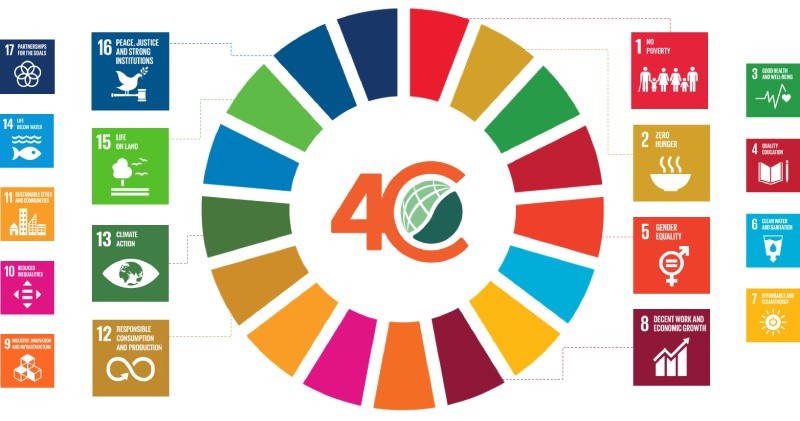
The guiding principle of sustainability certifications is to improve the present while preserving the future. Similarly, 4C aims to develop a world in which coffee and cocoa production not only ensures economic efficiency but also contributes positively to environmental protection and improved livelihoods.
Specifically, 4C aims to:
-
Create a transparent and traceable coffee supply chain
-
Ensure fair and humane working conditions
-
Protect the environment and reduce negative impacts from coffee production
-
Support farmers in improving income and competitiveness
These goals form the foundation for building a harmonious and sustainable coffee and cocoa supply chain that creates long-term value for all stakeholders — from farmers and businesses to global consumers.
Core Principles of 4C
The 4C system is built on four main groups of principles covering social, environmental, and economic topics. Farmers and businesses must comply with the following:
10 Unacceptable Practices
These are strictly prohibited. Any violation disqualifies a producer from certification:
-
Child labor
-
Forced labor or modern slavery
-
Discrimination
-
Unsafe or unhygienic working conditions
-
Inadequate housing for resident workers
-
Lack of access to clean drinking water
-
Deforestation of natural forests or high conservation value areas (HCV/HCS)
-
Farming on land involved in severe community conflicts
-
Use of chemicals banned under the Stockholm or Rotterdam Conventions
-
Failure to protect workers handling hazardous chemicals
11 Social Principles
These promote human rights, labor rights, living conditions, and gender equality:
-
Respect for labor and human rights
-
Non-discrimination
-
Freedom of association and collective bargaining
-
Safe and hygienic working conditions
-
Reasonable working hours and rest periods
-
Fair and timely wages
-
Skills training for workers
-
Gender equality
-
No harassment or workplace violence
-
Support for vulnerable groups
-
Protection of resident workers’ welfare
11 Environmental Principles
These focus on conserving natural resources and sustainable management of land, water, and energy:
-
Soil conservation and erosion prevention
-
Responsible fertilizer management
-
Water conservation and efficient use
-
Biodiversity protection
-
No deforestation or encroachment into sensitive ecosystems
-
Controlled and reduced use of hazardous pesticides
-
Protection of water sources from contamination
-
Agricultural waste management
-
Reduction of greenhouse gas emissions
-
Energy efficiency
-
Climate change adaptation
6 Economic Principles
These promote productivity, transparency, and market access:
-
Professional farm management
-
Monitoring of production inputs and outputs
-
Clear traceability
-
Access to technical and financial services
-
Fair value sharing within the supply chain
Evaluation Criteria in the 4C System
The 4C certification system is based on 12 core principles and translated into 45 detailed criteria, structured around three pillars: social, environmental, and economic.
Each criterion is classified into three compliance levels:
-
Mandatory
-
Continuous improvement
-
Recommended
This creates a flexible yet transparent improvement pathway across the entire coffee supply chain.
Benefits of Applying 4C in Coffee Production
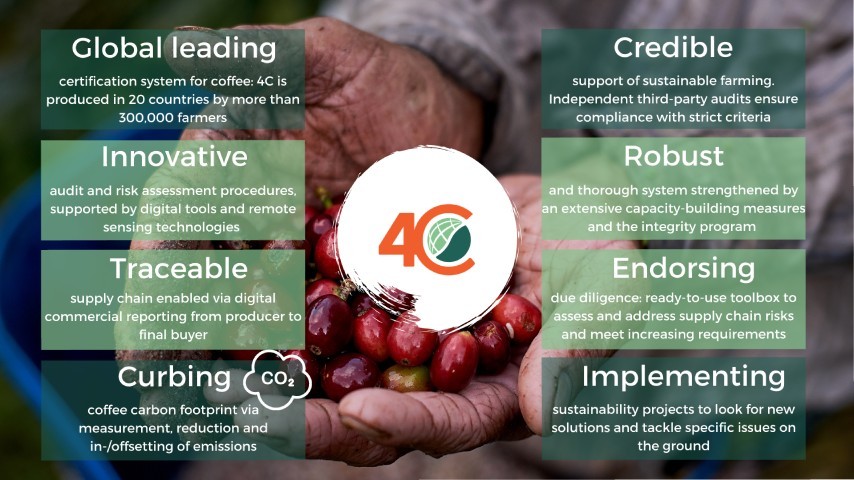
4C certification delivers comprehensive value to both producers and businesses.
For Farmers
-
Improved productivity and efficiency
-
Adoption of responsible farming practices
-
Technical training and environmental protection support
-
Better access to export markets
For Businesses and Roasters
-
Enhanced credibility and brand reputation
-
Transparent and traceable supply sources
-
Compliance with international standards (e.g., ISO 17065)
-
Supply chain risk assessment
-
Reduced carbon footprint through monitoring and emission measurement technologies
> See More: What Is The Rainforest Alliance (RA) Sustainable Agriculture Standard?
4C Certification Process
The certification process consists of three main stages:
Stage 1: Preparation
Producers conduct internal self-assessments, eliminate unacceptable practices, and establish an Internal Management System (IMS).
Stage 2: Evaluation & Certification
After submitting the application, an authorized certification body conducts an on-site audit. Upon successful evaluation, a 4C certificate valid for three years is issued.
Stage 3: Maintenance
Certification is not permanent. Annual Updates (AU) must be submitted, reporting progress improvements and verified 4C-compliant coffee volumes through the 4C portal.
Opportunities and Challenges for 4C Coffee in Vietnam
Vietnam is one of the world’s largest coffee exporters, especially known for Robusta. Implementing 4C certification offers clear advantages but also presents challenges.
Opportunities
-
Access to premium export markets
-
Increased brand value and global partnerships
-
Improved farming efficiency and resource savings
-
Enhanced product quality
Challenges
-
Initial investment costs for management systems and compliance
-
Limited awareness among smallholders
-
Resistance to changing traditional farming practices
The Way Forward
Successful expansion of 4C coffee in Vietnam requires collaboration among government agencies, businesses, development organizations, and farmers.
Financial support, technical training, cooperative linkages, and communication about sustainability benefits are essential to driving long-term success.
Tam Trinh Coffee – A Pioneer in 4C Sustainable Certification
Founded in 1995, Tam Trinh Coffee Import-Export Co., Ltd. carries the mission of elevating Vietnamese coffee on the global stage while improving farmers’ livelihoods and delivering clean, high-quality coffee to consumers.
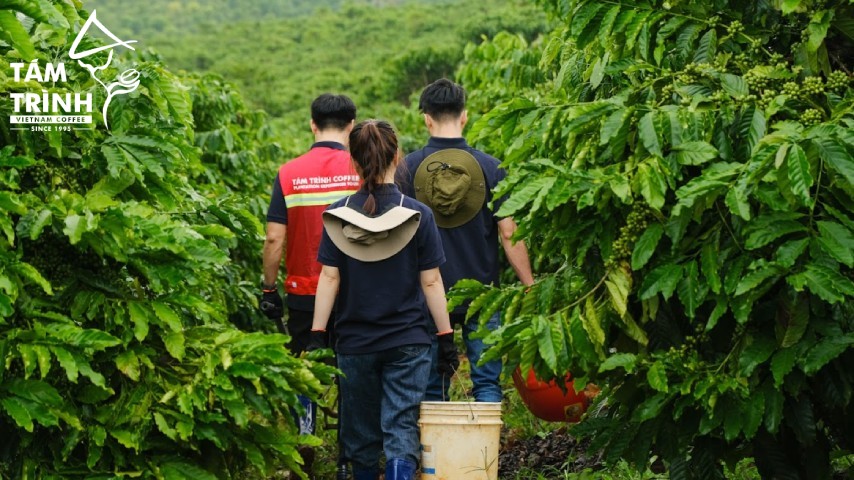
In 2022, Tam Trinh officially became a member of the global 4C Association, reaffirming its commitment to sustainable environmental, economic, and social standards.
The company has also obtained internationally recognized certifications such as UTZ and Rainforest Alliance (RA), ensuring premium quality and full traceability throughout the supply chain.
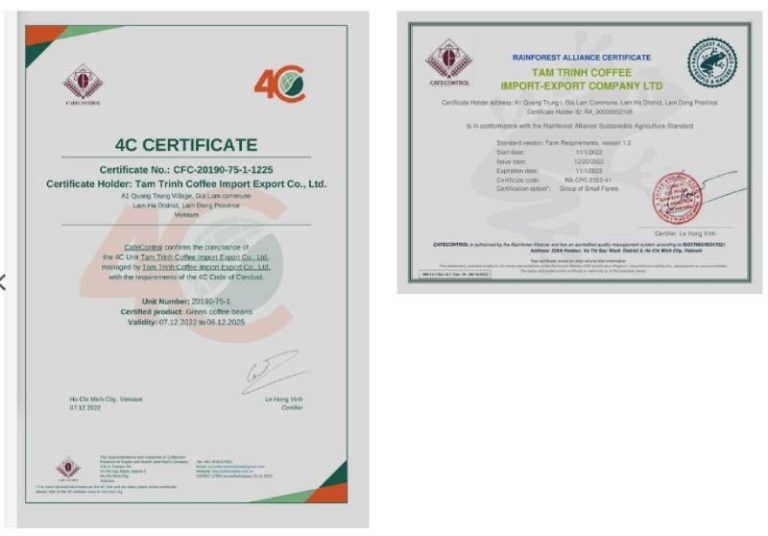
Become a partner of Tam Trinh today — and together, let’s deliver high-quality, traceable coffee that proudly represents the rich terroir of Lam Dong, Vietnam.