

News
Sustainable 4C Coffee – Paving The Way Toward A Greener Future For Vietnam’s Coffee Industry
As climate change, natural disasters, and resource depletion intensify, sustainability has become a global priority. In Vietnam, coffee—a cornerstone of the national economy—is increasingly shaped by sustainability standards, particularly the 4C (Common Code for the Coffee Community). But what exactly is 4C, and what benefits does it bring to farmers, businesses, and the environment? Let’s explore with Tám Trình Coffee.
What is the 4C Standard?
The Common Code for the Coffee Community (4C) is an entry-level sustainability standard designed to foster socially responsible, environmentally friendly, and economically viable coffee production. It is especially relevant for smallholders, cooperatives, and businesses starting their sustainability journey.
Objectives and Principles of 4C
The mission of 4C is to balance economic growth with environmental protection and social progress. Its specific objectives include:
- Establishing transparent and traceable coffee supply chains
- Ensuring fair and humane working conditions
- Protecting natural resources and minimizing production impacts
- Supporting farmers to enhance income and competitiveness
To achieve this, the 4C Code defines four principle groups:
- Unacceptable Practices (10 points): Strictly prohibits child labor, forced labor, unsafe working conditions, deforestation, use of banned chemicals, and other violations.
- Social Principles (11 points): Promote labor rights, non-discrimination, gender equality, safe workplaces, fair wages, training, and welfare for workers.
- Environmental Principles (11 points): Emphasize soil and water conservation, biodiversity protection, reduced pesticide use, waste management, energy efficiency, and climate adaptation.
- Economic Principles (6 points): Focus on professional farm management, monitoring yields, transparency, traceability, and fair benefit sharing.
Together, these standards create a holistic framework for sustainable coffee production.
Evaluation Criteria in the 4C System
The 4C framework translates its principles into 45 measurable criteria across three pillars—social, environmental, and economic. Each criterion falls into one of three categories: mandatory, continuous improvement, or recommended.
Social: Eliminating forced and child labor, ensuring safe and fair conditions, promoting equality.
Environmental: Conserving ecosystems, preventing deforestation, managing resources responsibly, cutting emissions.
Economic: Enhancing management, monitoring performance, ensuring traceability, and broadening market access.
This structure ensures transparent compliance while encouraging continuous improvement, ultimately raising product quality, improving farmer livelihoods, and protecting ecosystems.
Benefits of 4C for Coffee Production
Adopting 4C certification provides wide-ranging benefits:
For Farmers:
4C enhances productivity and efficiency through responsible farming practices and technical support. Smallholders gain access to export markets and can boost yields while reducing costs.
For Businesses:
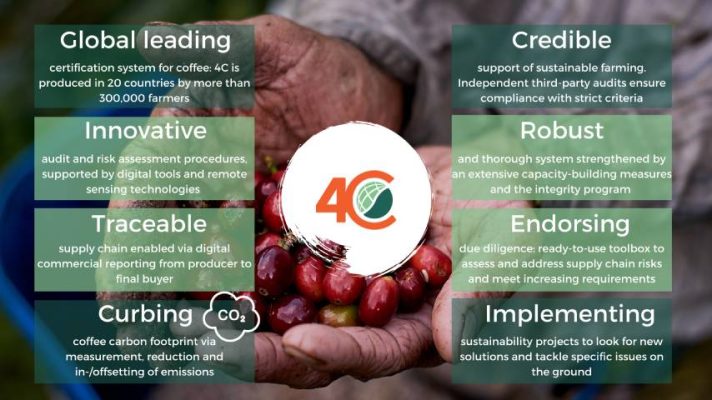
4C strengthens credibility by ensuring supply chains meet international standards such as ISO 17065. It supports legal compliance, reduces risks, and enhances brand image. With tools like carbon footprint monitoring and remote traceability, businesses can showcase responsible sourcing to global consumers.
The 4C Certification Process
The certification journey has three main stages:
Preparation: Farmers and cooperatives conduct self-assessments, eliminate unacceptable practices, and establish an Internal Management System (IMS).
Evaluation & Certification: A 4C-authorized body conducts an audit to verify compliance. Upon success, the entity receives a certificate valid for three years.
Maintaining Certification: Certified members must submit annual updates, documenting progress and volumes of 4C-compliant coffee via the 4C portal.
This process ensures that certified coffee remains aligned with sustainability standards over time.
4C Coffee in Vietnam: Opportunities and Challenges
As the world’s second-largest coffee exporter and the leading producer of Robusta, Vietnam stands to benefit significantly from adopting 4C.
Opportunities:
4C certification helps Vietnamese coffee access premium global markets where consumers demand traceability and sustainability. It boosts reputation, attracts partnerships with global roasters, and improves farming efficiency. Farmers benefit from higher yields, reduced costs, and stronger bargaining power.
Challenges:
Smallholders, particularly in remote areas, face difficulties implementing 4C due to upfront investment requirements and limited awareness of long-term benefits. Building internal management systems and maintaining records can be complex and resource-intensive.
Future Direction:
To expand 4C adoption, collaboration among government, businesses, NGOs, and farmers is essential. Financial support, technical training, and strong linkages between farmers and exporters are critical. Equally important is raising consumer awareness of 4C’s benefits, both domestically and internationally.
Tám Trình Coffee Import-Export Co., Ltd. – A 4C Pioneer
Founded in 1995, Tám Trình Coffee Import-Export Co., Ltd. has long been committed to elevating the global value of Vietnamese coffee, improving farmer livelihoods, and delivering clean, high-quality products.

In 2022, Tám Trình became an official member of the global 4C Association, reinforcing its pledge to sustainable practices across environmental, economic, and social dimensions. The company has also achieved international certifications including UTZ and Rainforest Alliance (RA), ensuring premium quality and transparent traceability from farm to consumer.

Partner with Tám Trình today—and together let’s deliver high-quality, traceable coffee beans that carry the unique signature of Lâm Đồng, Vietnam.