


News
Export Quality Standards for Robusta Coffee
Robusta coffee is the “heart” of Vietnam’s coffee industry, accounting for more than 90% of total production and serving as the backbone of the country’s coffee exports. However, international markets are becoming increasingly stringent regarding quality standards, cleanliness, uniformity, and traceability. Understanding and strictly complying with these requirements is the key for businesses to enhance product value, expand export markets, and build long-term credibility.
Join Tam Trinh Coffee as we explore the export quality standards for Robusta coffee in the article below.
WHY ARE ROBUSTA COFFEE EXPORT STANDARDS IMPORTANT?

TECHNICAL QUALITY STANDARDS FOR EXPORT ROBUSTA COFFEE
Moisture Content – A Critical Factor in Storage
Moisture content has a major impact on coffee quality throughout the supply chain. High moisture levels increase the risk of mold growth and the formation of harmful toxins such as Ochratoxin A and Aflatoxin B1.
To ensure quality, coffee must be dried to a moisture level of ≤ 12.5% (some markets require ≤ 12%) and stored under suitable conditions. Measuring moisture with specialized equipment before bagging is mandatory to maintain export standards.
Bean Size – Ensuring Uniform Roasting
Bean size is a key indicator of export quality. Beans of uneven size roast inconsistently, negatively affecting the final flavor profile. On international markets, beans with a screen size of 16 and above are highly valued and preferred for export. Uniform bean size ensures even roasting, stable flavor profiles, and higher commercial value.
Floaters Ratio – Evaluating Internal Bean Quality
Floaters are beans with low density, often underdeveloped or porous, which negatively impact flavor and product consistency. According to international standards, particularly those aligned with SCA, the acceptable floater ratio is generally below 3%, depending on quality grade.
For high-quality export Robusta, floaters should be almost completely eliminated (below 1%) through water flotation or gravity separation to ensure uniformity and roasting performance.
Foreign Matter
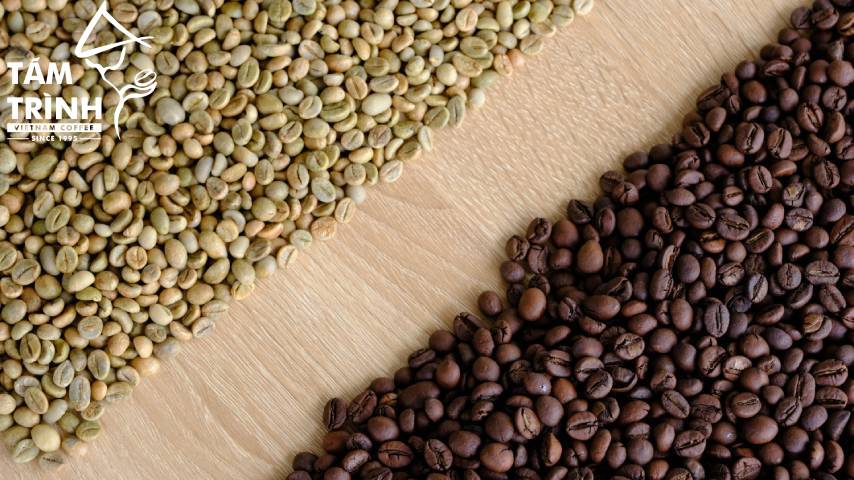
Foreign matter includes stones, sand, husks, strings, and metal fragments remaining after harvesting and processing. Acceptable levels usually range from 0.5% to 1%, depending on the target market. Poor control can damage roasting equipment, reduce purity, and negatively affect inspection results.
To ensure clean coffee, the use of impurity separators, vibrating sieves, and air-blowing systems is essential, helping to significantly enhance export value.
>> See more : Famous Coffee Growing Regions in Vietnam
Required Certifications
Sustainability certifications such as 4C (sustainable environmental practices), UTZ (responsible farming), Rainforest Alliance (deforestation prevention and labor protection), and Organic (chemical-free farming) are increasingly important depending on target markets.
In addition, traceability has become a critical requirement in modern supply chains, especially in Europe and the United States, ensuring transparency and strengthening product credibility on the global market.
WHAT QUALITY STANDARDS IS TAM TRINH COFFEE APPLYING?
At Tam Trinh Coffee, quality is not just a commitment—it is a mandatory standard throughout the entire production and export chain. We apply strict international standards to ensure Robusta coffee is high-quality, uniform, and food-safe for global partners.
Technical Standards in Line with TCVN and SCA
-
Moisture content: ≤ 12.5% in accordance with TCVN 4193:2011 and international market requirements. Some lots are controlled at ≤ 12% to meet specific demands from EU and US roasters.
-
Bean size: Screen 16 and above, uniform, suitable for international commercial grading (Grade 1 & 2).
-
Floaters ratio: < 1%, checked and separated using modern gravity sorting machines.
-
Foreign matter: < 0.5%, cleaned using advanced vibrating sieves and air separation systems to minimize processing risks.
Transparent Traceability System
Tam Trinh applies a full traceability system from farmers – processing plant – storage – transportation, ensuring transparency across the entire supply chain and meeting EU market requirements, including the latest EUDR (EU Deforestation Regulation).

International Certifications Applied
Depending on market demand, we supply coffee certified with:
-
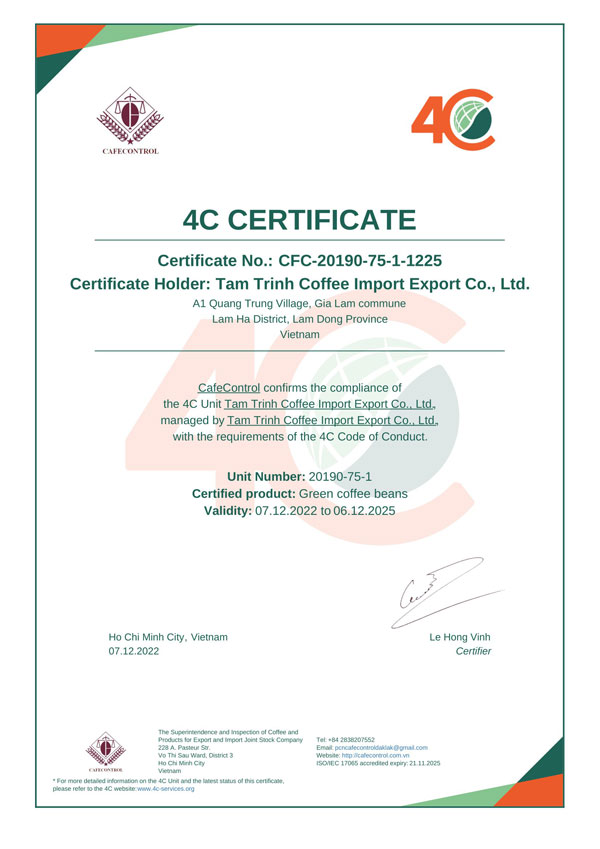
4C: Promoting sustainable farming, environmental protection, and social fairness.
-
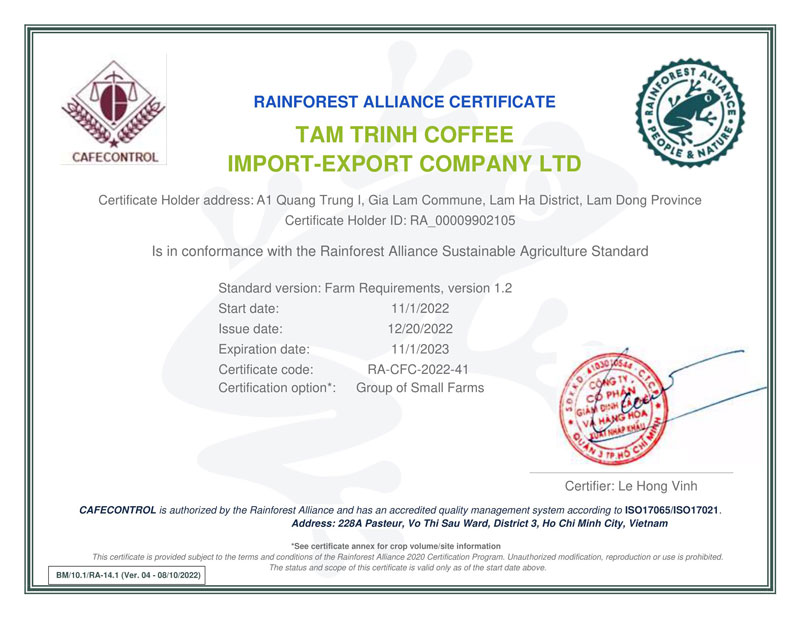
Rainforest Alliance: Preventing deforestation, protecting ecosystems, and safeguarding workers’ rights.
-
UTZ (now merged with Rainforest Alliance): Ensuring transparent and responsible production.
-
Organic: 100% chemical-free products for premium markets (EU/USDA Organic).
Strict Internal Quality Control Process
-
Application of HACCP quality management throughout processing, storage, and export stages.
-
Each shipment is inspected prior to dispatch, with clear quality inspection reports and samples, accompanied by a COA (Certificate of Analysis) when required.
TAM TRINH COFFEE IMPORT–EXPORT CO., LTD.
A Trusted Robusta Coffee Exporter from Lam Dong
Tam Trinh Coffee Import–Export Co., Ltd. is proud to be a reputable Robusta exporter from Lam Dong, a region renowned for its ideal climate and soil conditions for coffee cultivation. We specialize in supplying high-quality Robusta green beans and raw materials that meet strict export standards for demanding markets such as Europe, the United States, Japan, and the Middle East.
With a closed-loop production process, strict quality control, and an experienced technical team, Tam Trinh is committed to delivering clean – standardized – sustainable coffee, contributing to elevating the value of Vietnamese coffee on the global stage.
Tam Trinh Coffee – From the highlands of Lam Dong to the world.
Contact us today for pricing and coffee samples.
FAQ: Export Quality Standards for Robusta Coffee
Why must export Robusta coffee comply with quality standards?
To ensure product consistency, enhance brand credibility, and meet the stringent requirements of international markets.
How do quality standards affect Robusta coffee prices?
Higher-quality coffee typically commands better commercial value and easier access to major export markets.
Which factors are used to evaluate Robusta coffee quality?
Bean appearance, uniformity, cleanliness, flavor profile, and safety during production and storage.
Which markets require the highest quality standards for Robusta coffee?
Markets such as Europe, the United States, and Japan apply particularly strict requirements for quality and traceability.
What benefits do quality standards bring to businesses?
They help expand export markets, improve competitiveness, and build a sustainable image for Vietnamese coffee globally.