


News
Famous Coffee Growing Regions in Vietnam
Coffee was introduced to Vietnam in the late 19th century during the French colonial period and quickly gained popularity. Over time, coffee became a strategic crop with high economic value. After more than a century of development, Vietnam has not only become the second-largest coffee exporter in the world, but also established a collection of unique and renowned coffee-growing regions, creating one of the richest and most diverse flavor maps in Asia.
However, not every region is suitable for growing high-quality coffee. Coffee plants require specific conditions such as altitude, soil composition, climate, rainfall, and proper farming practices to thrive and develop distinct flavor characteristics. In today’s blog, let’s join Tam Trinh Coffee in exploring the major coffee-growing regions along the S-shaped land of Vietnam.
Key Characteristics of Major Coffee-Growing Regions in Vietnam
| Region | Average Altitude | Main Soil Type | Typical Coffee Varieties | Notable Flavor Characteristics |
|---|---|---|---|---|
| Northwest | 800 – 1,500 m | Feralit soil, sandy mix, mineral-rich | Arabica (Typica, Bourbon) | Bright acidity, fresh fruity aromas, light sweetness, clean finish |
| Central Highlands | 500 – 800 m (Robusta); over 1,200 m (Arabica) | Red basalt soil formed from volcanic lava | Robusta, Arabica, Culi | Full-bodied, high caffeine, low acidity, chocolate – caramel – buttery notes |
| Central Region (Khe Sanh, Phu Quy) | 400 – 800 m | Red basalt soil mixed with clay | Catimor (Arabica × Hybrid de Timor) | Deep aroma, mild astringency, subtle salinity, long-lasting aftertaste |
Tam Trinh Coffee warmly invites you to explore each region’s altitude, terroir, and flavor profile to understand why Vietnamese coffee expresses such remarkable regional diversity.
1. THE NORTHWEST – “THE ARABICA VALLEY” OF VIETNAM
The Northwest is the cradle of Vietnamese Arabica coffee, with prominent areas such as Son La, Dien Bien, Muong Ang, and Moc Chau. The terrain combines mid-altitude mountains and plateaus, forming independent microclimates with average temperatures of 18–22°C, light morning mist, and significant day–night temperature variation.
-
Altitude: 800 – 1,500 meters above sea level
-
Soil: Red-yellow feralit soil on shale and sandy basalt, well-drained, rich in silica and potassium
-
Varieties: Arabica (Typica, Bourbon, Catimor)
Flavor Profile:
Northwest coffee, especially from Son La, features bright, gentle acidity with notes of citrus, jasmine, and honey. The finish is clean, sweet, and refined—an unmistakable signature of regions with high diurnal temperature variation, allowing coffee cherries to ripen slowly and develop complex aromas.
Highlight:
Son La Arabica Specialty Coffee is often described as “a flower blooming on the palate,” offering wild citrus notes, lively acidity, and a smooth honey-like sweetness.
2. THE CENTRAL HIGHLANDS – “THE ROBUSTA CAPITAL” OF THE WORLD
Vietnam’s Most Important and Renowned Coffee-Growing Region
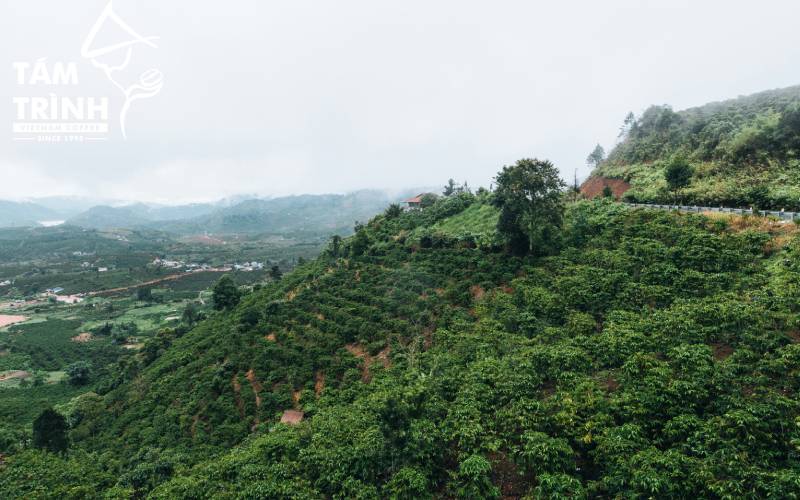
The Central Highlands is the heart of Vietnam’s coffee industry, accounting for over 80% of the country’s total production. This region includes Dak Lak, Gia Lai, Dak Nong, Kon Tum, and Lam Dong.
-
Altitude: 500 – 800 m (Robusta); above 1,200 m (Arabica – Lam Dong)
-
Soil: Volcanic red basalt soil rich in iron, magnesium, and organic matter; pH 5.5–6.5—ideal for coffee cultivation
-
Climate: Two distinct seasons—rainy season for fruit development, dry season for ripening; average temperature 22–25°C
Flavor Profile:
-
Central Highlands Robusta: Bold, intense, low acidity, high caffeine content with flavors of dark chocolate, caramel, roasted nuts, and occasionally hints of butter or smoke.
-
Lam Dong Arabica (Cau Dat, Di Linh): Elegant aroma, gentle berry-like acidity, long finish—widely regarded as the finest Arabica in Vietnam.
Notable Areas:
-
Buon Ma Thuot: Known as the “Coffee Capital of the World” for its outstanding Robusta quality.
-
Cau Dat (Lam Dong): The highest Arabica-growing region in Vietnam, offering a balanced profile of acidity, sweetness, and bitterness with a smooth chocolate finish.
3. THE CENTRAL REGION – “THE LAND OF CATIMOR”
The Central region, particularly Khe Sanh (Quang Tri) and Phu Quy (Nghe An), may not boast ideal altitudes (400–800 m), yet it offers unique climatic and soil conditions that allow the Catimor variety to thrive.
-
Soil: Red basalt soil mixed with clay, excellent moisture retention while maintaining good drainage
-
Climate: Dry, hot Lao winds alternating with heavy rainfall, resulting in thicker skins, harder beans, and deeper flavors
Flavor Profile:
Central Vietnam coffee often presents deep aromas, mild astringency, subtle salinity, and a long-lasting finish. Catimor grown in Khe Sanh carries smoky, earthy notes, while Phu Quy coffee is bolder with a slight mineral character influenced by ancient volcanic geology.
Although coffee acreage in this region has declined, Khe Sanh remains a pioneering area for specialty Arabica in Central Vietnam.
About Tam Trinh Coffee
With over 30 years of experience in coffee production and export, Tam Trinh Coffee Import–Export Co., Ltd. continuously strives to bring Vietnamese coffee to the global stage. In Lam Dong, we develop our coffee-growing regions through close partnerships with more than 3,000 farming households, focusing on internationally certified standards such as 4C, UTZ, and Rainforest Alliance, promoting sustainable farming, resource efficiency, and environmental conservation.
To achieve optimal cherry ripeness (95–99%) and sugar levels of 17–21 Brix, we implement incentive programs for farmers, provide pre-season training, conduct post-harvest quality inspections, and collaborate with experts to continuously improve cultivation, harvesting, and processing methods.
Tam Trinh Coffee not only supports agricultural techniques but also transfers modern processing and roasting technologies to enhance productivity and bean quality. From seed selection and hand-picked harvesting to natural processing and precision roasting, every step is strictly controlled at our Nam Ban facility—ensuring each batch preserves the authentic flavors of Vietnam’s highlands.
Beyond the domestic market, Tam Trinh Coffee partners with clients worldwide to introduce Vietnamese coffee to demanding international markets. Guided by our philosophy “Honest Coffee – A Sustainable Journey,” we believe that from the red basalt soils of the Central Highlands, to the cool climate of the Northwest, and the clay-rich basalt of the Central region, each area contributes to Vietnam’s diverse coffee flavor mosaic. It is this unique combination of geography, climate, and terroir that gives Vietnamese coffee its distinctive fingerprint and secures its place on the global coffee map.
FAQ: Vietnamese Coffee-Growing Regions
What are the main coffee-growing regions in Vietnam?
The key regions include the Central Highlands, Cau Dat – Da Lat, parts of the Southeast, and the Northwest.
Which region produces the most coffee in Vietnam?
The Central Highlands is the largest coffee-growing area, accounting for over 90% of national output.
What type of coffee is mainly grown in the Central Highlands?
Primarily Robusta, known for its bold flavor, strong bitterness, and high caffeine content.
Where is Arabica coffee grown in Vietnam?
Arabica is mainly cultivated in Da Lat, especially in the Cau Dat area.
Why is Cau Dat considered a specialty coffee region?
Thanks to its elevation above 1,500 meters, cool year-round climate, and fertile basalt soil, producing Arabica beans with delicate aromas, bright acidity, and sweet aftertaste.
What are the main coffee varieties in Vietnam?
Arabica and Robusta are the primary varieties, with smaller quantities of Liberica and Excelsa.